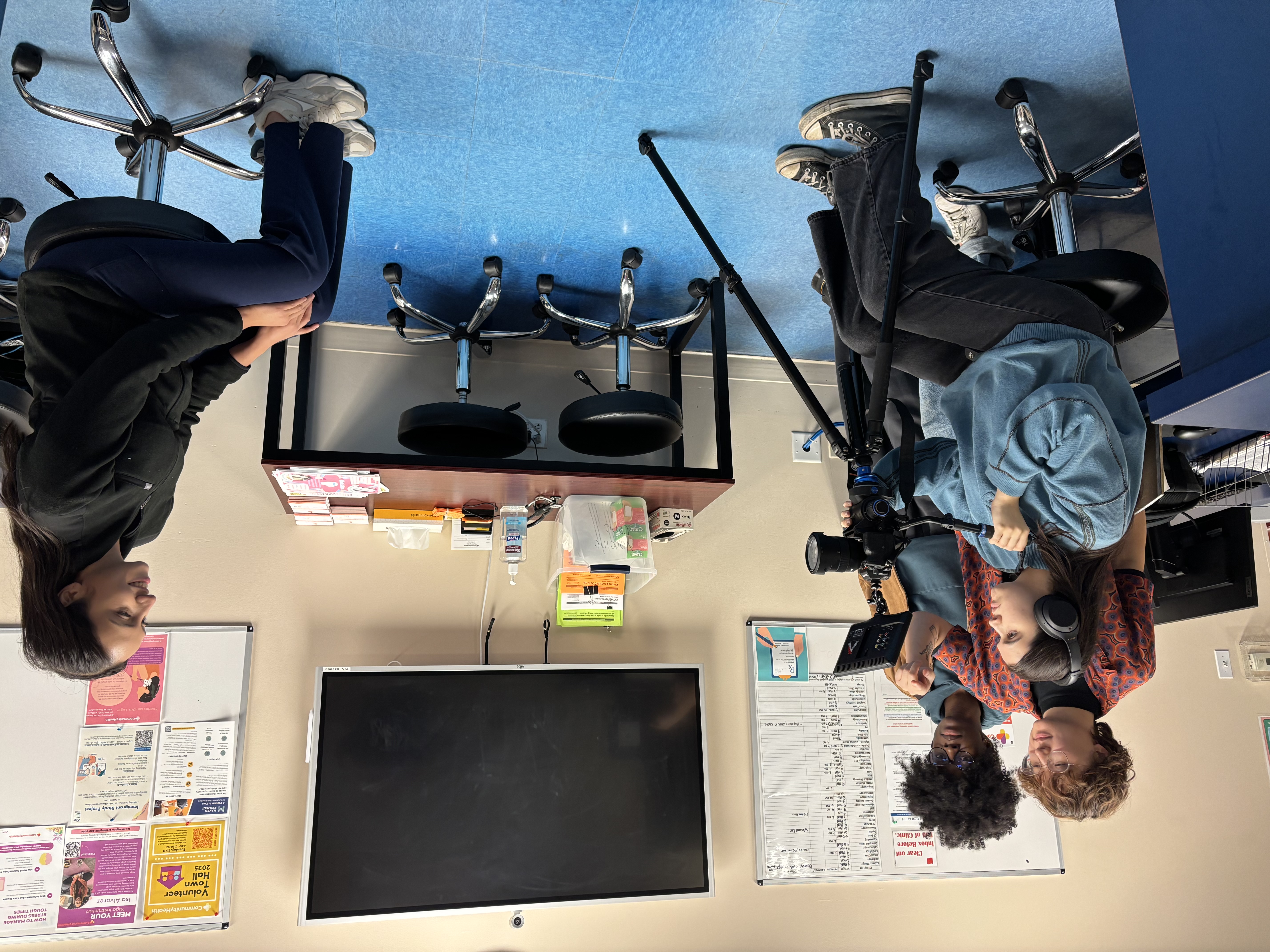
 Sofia Santos, Alice Woo and Miram Amoako-Kankam recording an instructional video in Spanish about diabetes glucometers with a CommunityHealth volunteer (Photo courtesy of Jay Baglia).
 In CommunityHealth's waiting room, a video features information on patients' rights and the organization's commitment to their safety and dignity in three languages: English, Spanish and Polish. Two DePaul students and Professor Jay Baglia created that video, the first in a series funded by a grant from the DePaul Migration Collaborative's Solutions Lab.
“It's a really Vincentian project about human dignity and personalism," Baglia says. “Students need the experience of interacting with a public outside of the university. Everybody brings something important to the puzzle, and it's been thrilling to reach the end stage of making the videos available for patients."
Every year, some 4,000 uninsured Chicagoans receive essential healthcare through CommunityHealth, the largest volunteer-based provider of free medical services in the nation. The organization relies on volunteer physicians and nurses who donate their time to care for the uninsured, including migrants and undocumented people in Chicago.
For Alice Woo, the funder and donor relations manager at CommunityHealth, collaboration is key to innovation and improving care for their patients, including this partnership with DePaul students and faculty. As the organization sought to accommodate patient hesitancy to gather onsite, there was a need to improve communications for both telehealth volunteers and patients. In 2024, Woo reached out to Baglia with the idea of creating informational videos, allowing patients to rewatch as needed from their homes.
While Baglia had never produced videos before, he was up for the challenge. “My area of expertise is turning complicated biomedical language into plain language for patients," says Baglia, who teaches health communication and other subjects in DePaul's College of Communication.
Baglia sought out a student for video production support, giving an impromptu pitch to cinematography senior Sofia Santos when he noticed her setting up to film a project. She joined the project and leads the filming and editing of each video.
“The videos were taken at our clinic with staff members who patients recognize. This will enhance our patients' ability to engage in health programming remotely," Woo says. “We also have a Spanish-speaking and Polish-speaking patient advisory council whose feedback helps influence what we do."
The group is currently working on a series of short videos about diabetes that support the health education component of the organization's diabetes care program. Each set of videos will be shot in both Spanish and Polish, with English captions, and made available on YouTube. The videos are also culturally specific, including sample recipes aligned with cultural diets.
Miriam Amoako-Kankam, a second-year graduate student in the Refugee and Forced Migration Studies program, is a research assistant for the project. She helps to document the process and research the populations that CommunityHealth supports. She's driven by a sense of duty, she explains, to help those who need it.
“Through what I've experienced and learned in my program, I know that these are people who could benefit from free healthcare the most. If I could be a part of a project that's going to give healthcare to people, it would be wrong for me not to help," Amoako-Kankam says.
Amoako-Kankam knows the importance of supporting those who are often sidelined as she founded a non-profit in Ghana to provide mental health support and clothes for refugees. This experience researching the healthcare safety net for migrants in Chicago is helping her build a foundation for her dream career in immigration law.
Next, Amoako-Kankam will conduct interviews with CommunityHealth volunteers about their experience with the organization. These interviews will be used both as research and testimonials to support volunteer recruitment and onboarding process.
The DePaul Migration Collaborative's Solutions Lab is designed to foster interdisciplinary, community-engaged research projects. Successful collaborations involve scholars and community partner organizations working hand in hand to identify and address critical areas of need. Learn more about the lab and past projects online.