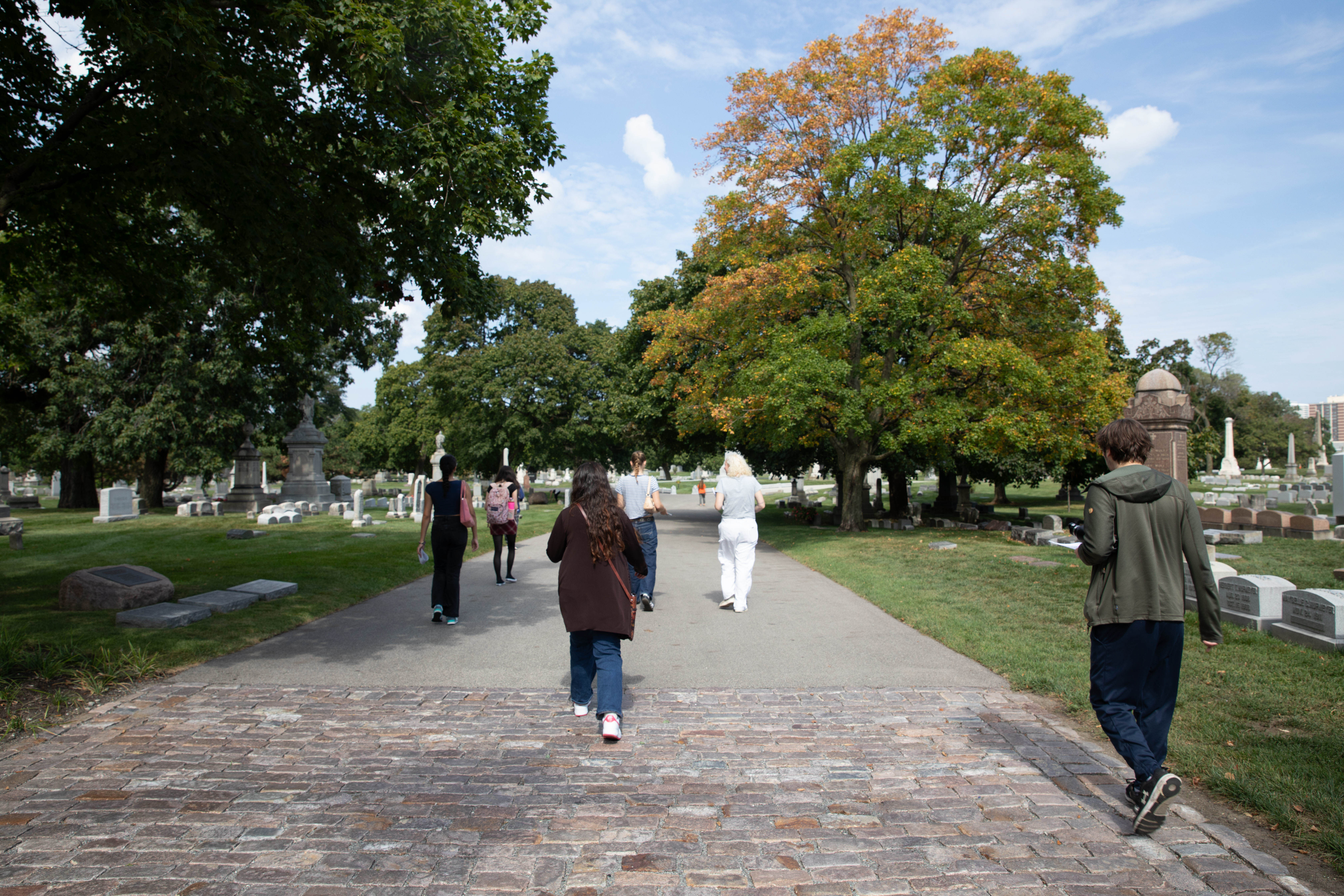
 Every Hidden Narratives course visits Graceland to prepare for their projects (Photo by Lavanya Chetal/DePaul University).
 Aleksa Kirkus, a senior anthropology major, and her classmates noticed adults are often unsure how to address death and loss with their children at Graceland Cemetery in Uptown. For an anthropology class last spring, Kirkus and her group members—including Maaneli Evans, Veronica Gomez, Naomi Greene, and Maria Merlos—were tasked with making the cemetery more accessible to children.
The students created a coloring book that doubles as a storybook and tour of the cemetery. As children color the pages, the characters talk about feelings, death, Chicago history and architecture in a family-friendly way. The book will be published this fall, with Kirkus and her group presenting their work at
Open House Chicago on October 19.
“It is affirming to realize that the work I am doing in a class will benefit and help a community,” Kirkus says. “That is what applied anthropology is about! Of course it is important to write and study theory, but it feels amazing when you can put that into practice.”
The class is part of DePaul’s Hidden Narratives Initiative at Graceland Cemetery. Launched last year,
the collaboration, spearheaded by Anthropology faculty members
Michelangelo Giampaoli and
Jane Baxter, supports community-engaged and project-based courses that use archives from Graceland’s collection to highlight hidden stories. The student-directed projects are presented to Graceland staff to be integrated into their offerings once the course is completed.
“Cemeteries operate with relatively small staff, and we don’t have the bandwidth to create these kinds of projects on our own,” says Jensen Allen, on-site director at Graceland Cemetery. “Having student-produced content that we can add into our app and website has been incredibly helpful.”
Cemeteries around the country collaborate with community organizations to create educational programs, and Graceland is leading the effort in Chicago. Giampaoli credits Graceland’s initiative in providing hands-on educational opportunities for students and the larger Chicago community.
The project has thus far supported an anthropology course on accessibility and another on women writers, demonstrating the potential for cemeteries as sites for education in a wide range of academic fields.
Students offer unique perspectives to ‘antiquated’ field
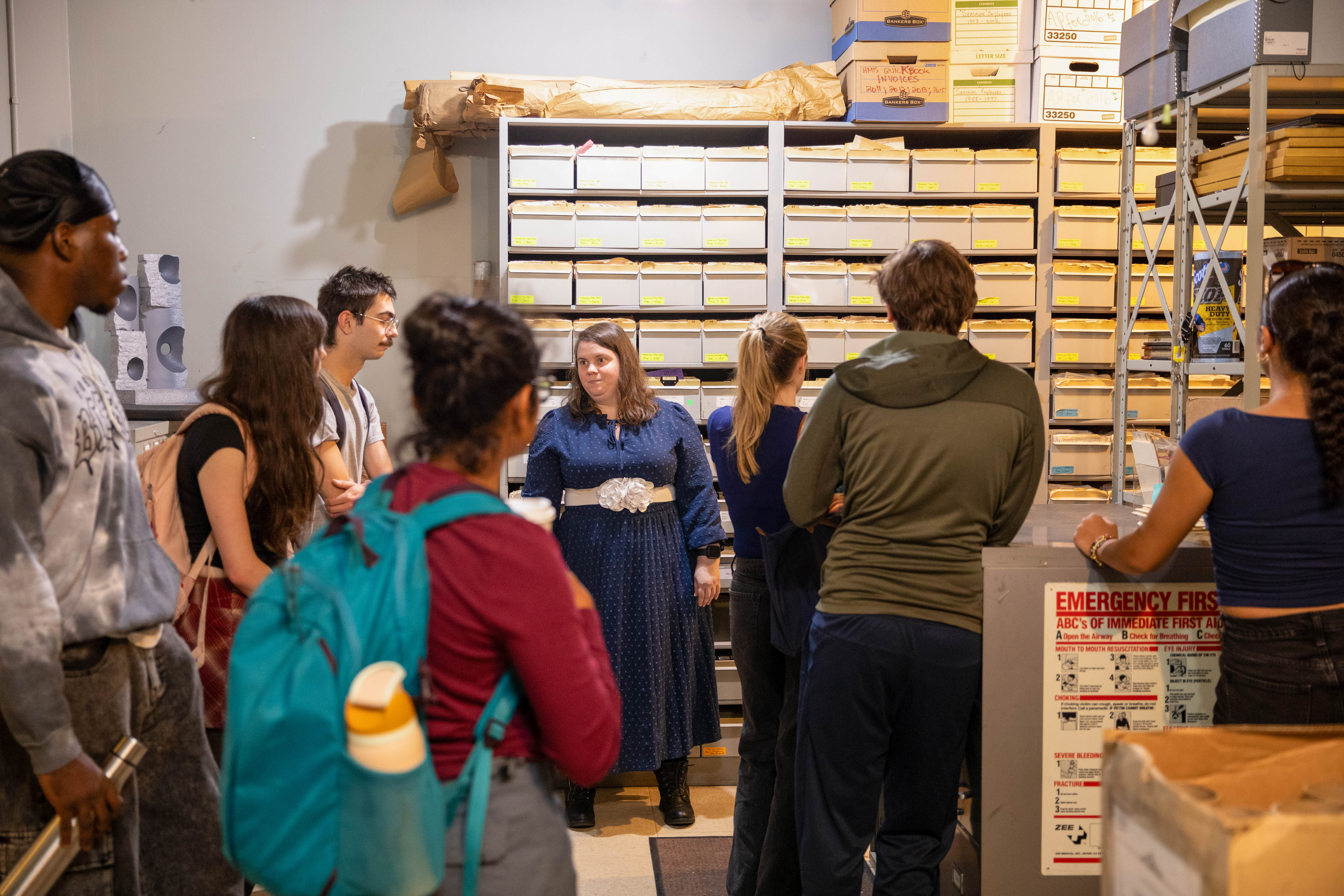 Jensen Allen, onsite director at Graceland, takes students through the cemetery's archives (Photo by Lavanya Chetal/DePaul University).In the first Hidden Narratives course last spring, Kirkus and her fellow students decided how they wanted to address the topic of accessibility at Graceland. Students led the projects at every stage: from brainstorming, to research, in person interviews, photography, and presenting the projects to Graceland staff for feedback.
The current Hidden Narratives course, taught by associate professor
Julie Bokser, creates audio tours highlighting women buried at Graceland who are writers and rhetors. Exploring Graceland’s archives as well as resources from the Newberry Library and the Chicago History Museum, students also research the rhetoric of audio tours and create their own tour to share the stories of notable women among Chicago’s male-dominated narrative of history.
Students met with Allen on a recent visit to Graceland. “They asked questions about Graceland’s expectations, how the cemetery feels about their existing tours and if there are any restrictions on what can be written,” Bokser says. “This is a good client interaction experience as if the students are freelancers.”
Allen, with the cemetery, says she’s looking forward to seeing what the students create for Bokser’s class, as well as the upcoming course using virtual reality.
“I love working with college students because they bring a unique perspective to a line of work that can be quite antiquated,” Allen says. “They want to be helpful, really care about implementation and ask great questions.”
Upcoming Hidden Narratives course topics include investigating health disparities in America, sharing immigrant stories through augmented reality experiences and educating about laborers who built the monuments or are buried at the cemetery. Students interested in enrolling in the next Hidden Narratives course can check out HON 350: Health Disparities taught by health sciences associate professor
Jessica Jerome.
For more information on the Hidden Narratives Initiative, visit the
website.