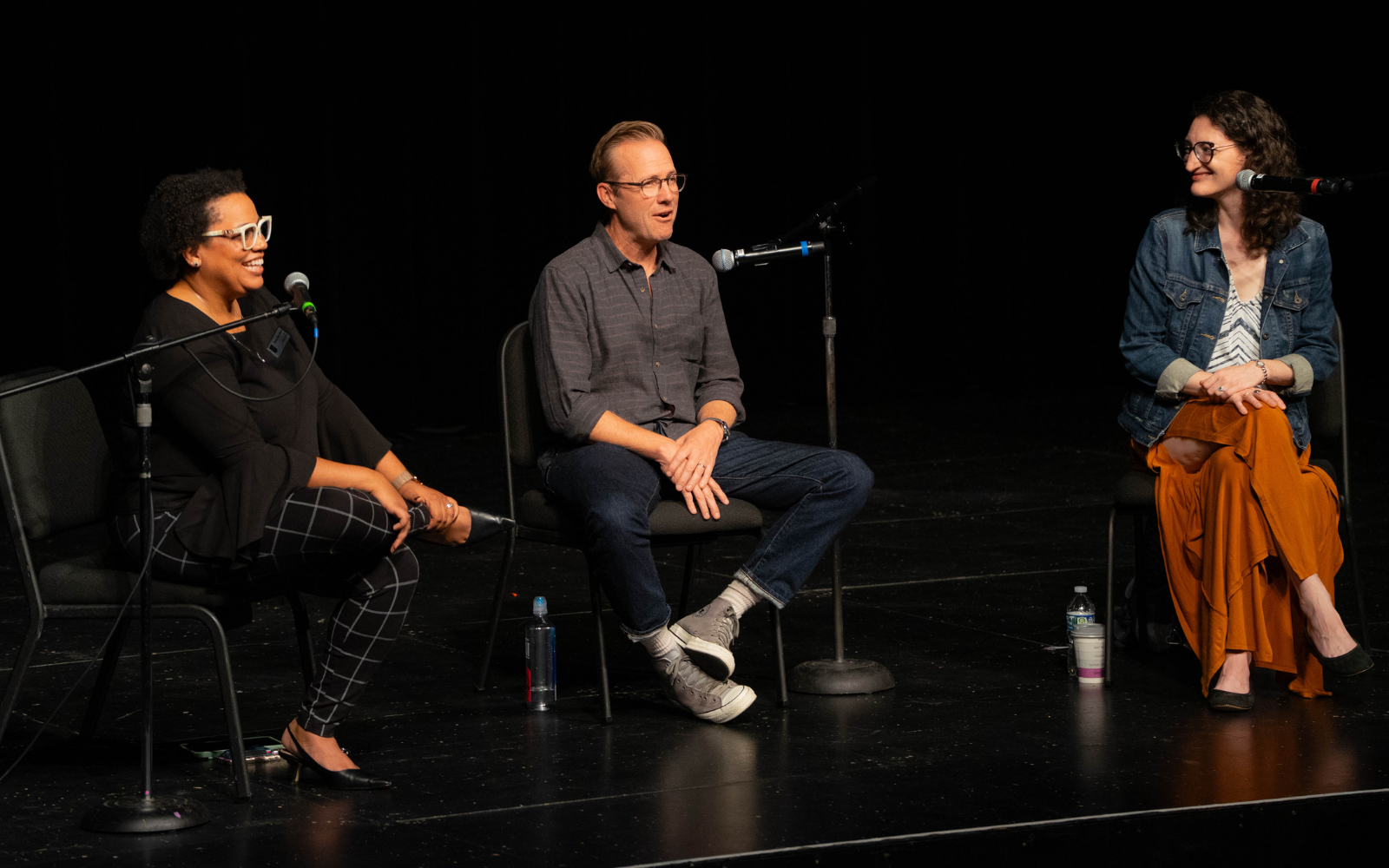
Martine Kei Green-Rogers, dean of The Theatre School, spoke with Lee Kirk, writer of "Ashland Avenue" and Kat Zukaitis, director of new works at the Goodman Theatre, on Sept. 21. (Photo by Matthew Eshaya)Before Lee Kirk came to study at DePaul, he had never set foot in Chicago. Now his play about the city,
“Ashland Avenue,” is opening the Goodman Theatre’s centennial season while his latest film,
“New Year’s Rev,” premieres on festival screens. On Sept. 21, Kirk (BFA ’96) visited with students, faculty and alumni at
The Theatre School to reflect on his professional path and the writing process for his play, which runs through October 12.
“Ashland Avenue” stars Kirk’s wife and “The Office” star Jenna Fischer and longtime Chicago actor Francis Guinan. The play is a loving portrait of community in Chicago and follows the story of a father and daughter who own a TV store on Ashland Avenue that’s past its prime.
We sat down with Kirk to discuss his time at DePaul and how it shaped his creative endeavors throughout his career.
This event is a homecoming for you. Can you tell me about your time at DePaul?
I had not been to Chicago when I applied; I auditioned for DePaul in New Orleans. When I came here, I was instantly fascinated with the city, and I would walk a lot. I had a girlfriend who lived on the other side of Lincoln Park, so I would walk over there every night. I would pick a different route each night, and I deeply felt the history of the city.
Of course, DePaul itself was a big shift. I came out of high school, where doing a play or musical wasn’t a big deal. Then I came here, and all these faculty took it so seriously. It was a realization that this was a real profession, and I needed to up my game a little bit to hold my own. I loved how everyone took the work very seriously and was trying to explore what it is to be human. I feel like the seeds of who I am now really started at the theater school. I learned so much about who I was and what I had to say to the world.
What was your writing process for ‘Ashland Avenue’?
I came here in the summer of 2023, and I realized how much I missed the city. I'd been tinkering with ideas for a play, and I couldn't find my way into one. It hit me when I was here that my way in was Chicago, writing a play about all these feelings I had for the city. Then, on the plane ride home, I started writing the play. I just started writing, sketching out the first scene, and it became something I did all the time. I would take my kids to school every morning, come home and work on the play. There were other things I should have been working on, but this play just took hold of my imagination.
There were a lot of moments when I would ask myself, “Why am I writing this? No one is asking for my play.” I had to silence that critic and keep plowing through, because I felt such a connection to the material.
One thing that stands out during the show is that the set feels very immersive. How did your vision of the setting and characters change as it was brought to life on stage?
The director, Susan Booth, nailed it. She wanted to create exactly what you're saying — an immersive experience. Something that she insisted on, which I thought was brilliant, was that they would actually make coffee, and it would brew right there. When the characters make popcorn, it pops right in the moment. We had to time out the scene so the popcorn was done popping at the right time. It's that kind of detail that gives you that immersive experience.
There are things about the wardrobe, the costumes — shoes that get salt on them when they salt the streets, and it feels like those actors inhabit the cold that's outside. You feel the winds out there; it's cold outside, and this TV shop becomes what Pete [the shop owner] says it is. It's a lighthouse in the community, and it's warm. The lighting in there is warm, and it feels inviting, and that was essential to the play.
What advice do you have for students in creative fields?
The most important thing I've learned in my time as a filmmaker and a writer is that you have to find out what your voice is and lean into it. You have to be unique. You have to be yourself. For Theatre School students, but also students in the music school, film school or anyone studying the arts, what makes your work special is the thumbprint that you put on it and the point of view you're communicating. Lean into that and express yourself fully through your work.