.png)
CyberLabs Signage (Tom Vangel/DePaul University)
.png)
Students demonstrate a quadruped robot in the robotics lab (Jacob Cagle/DePaul University)
.png)
Students monitor real-time cyber activity inside the Bunker (Jacob Cagle/DePaul University)
.png)
Student controls a machine using his brainwaves (Jacob Cagle/ DePaul University)
.png)
Student engages with talking robot (Jacob Cagle/DePaul University)
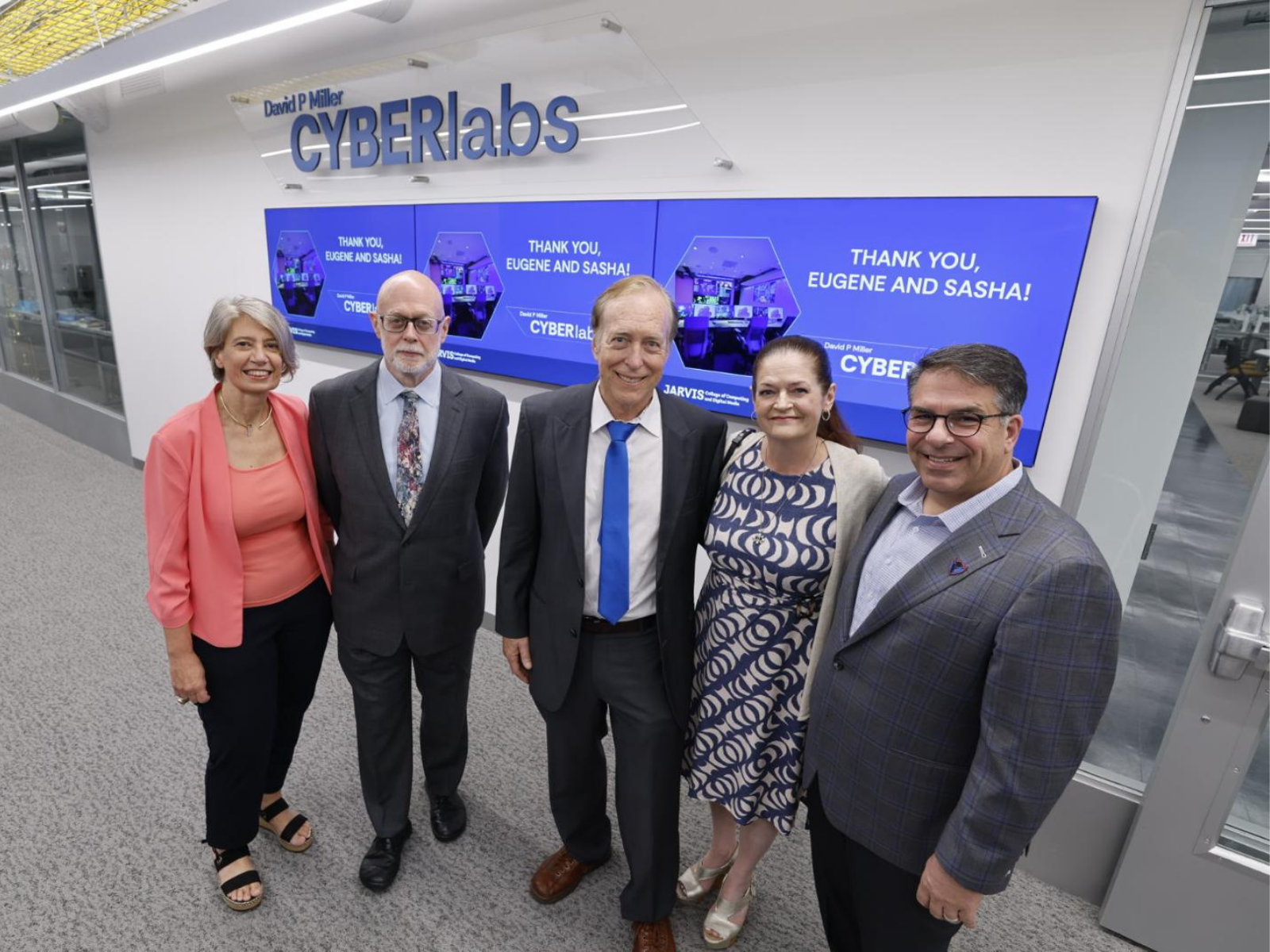
Lucia Dettori, David Miller, Eugene Jarvis, Sasha L. Gerritson, and President Rob Manuel in front of the Cyberlabs signage (Tom Vangel/DePaul University)
Located on the third floor in the Jarvis College of Computing and Digital Media, the newly opened David P. Miller CyberLabs are designed to prepare the next generation of DePaul engineers, computer scientists and innovators. The CyberLabs were named to recognize and honor David Miller, dean of the college from 2007-2022, through a generous gift from video game pioneer Eugene P. Jarvis and his wife, Sasha L. Gerritson (MUS '99), a DePaul trustee and alumna. With spaces tailored for students in cybersecurity, robotics, artificial intelligence and intelligent systems engineering, the labs mark a bold step forward in DePaul's commitment to advancing technological education and research.
“At DePaul, we view technology as a tool for transformation, empowering students to tackle the pressing challenges of our time. The new CyberLabs equip our students with advanced technologies and real-world systems to push the boundaries of robotics, artificial intelligence, and cybersecurity. There, learning extends beyond the classroom, as students seamlessly transition from coursework to hands-on projects, blending theory with practical applications," says Lucia Dettori, interim dean of the Jarvis College of Computing and Digital Media.
Spanning more than 11,000 square feet, the CyberLabs is organized into two main areas: the Cybersecurity Suite and the Engineering Labs. The Cybersecurity Suite includes the Bunker, GLITCH, the Network and Security Lab with a dedicated server room, and a classroom focused on intelligent systems. The Engineering Labs feature the Robotics and AI Lab, as well as the Engineering Projects and Prototype Lab.
In the Robotics and AI Lab, students program robot arms, humanoids, quadrupeds and even deploy machine-learning algorithms to control swarms of drones.
"Programming a physical object and watching it move can be life-changing — it was for me. I want to make that experience contagious for Blue Demon students," says Umer Huzaifa, an assistant professor in the School of Computing. DePaul launched a new undergraduate major in robotics this fall.
"The curriculum is designed to cover three major modalities of robotic platforms: aerial, walking and wheeled robots. We plan to enhance the current Intro to Robotics course with new mobile robot platforms, while also introducing dedicated course sequences in aerial robotics and legged locomotion. A dedicated flying arena, equipped with state-of-the-art motion capture cameras, will further enable the design and testing of highly precise motion plans," Huzaifa adds.
The Cybersecurity Suite begins with the Bunker, a real-time command center with two 3×3 video walls that allow students to coordinate and respond to simulated cybersecurity threats as unified teams. These exercises mirror professional security operations with attackers and defenders working under pressure at the same time. DePaul offers majors in cybersecurity at both the undergraduate and graduate level. DePaul University is a designated center of excellence in cyber defense by the National Security Agency.
Hands-on training continues in the General Lab for Integrated Tech, Cybersecurity & Hardware (GLITCH), which includes real systems such as voting machines, industrial control equipment, medical devices, WiFi analysis tools, and a range of mobile and IoT platforms. Students investigate vulnerabilities across both legacy and modern technologies, gaining an understanding of how weaknesses appear in systems built for safety or convenience. Virtual labs in the Server Room support coursework and research with over 1,500 virtual machines that can simulate industries, threat environments, and enterprise-scale networks, making it possible to test developing tools such as small AI models and cloud systems.
“We build cybersecurity expertise through a blend of theory and application," says Ryan Haley, professional lecturer in the School of Computing. “In the classroom, students develop a deep understanding of modern security frameworks. In the lab, they put those principles into practice through direct engagement with real systems and infrastructure. Graduates emerge with both hands-on experience and a solid foundation in cybersecurity theory, fully prepared to contribute on day one in any professional security environment."
The Engineering Projects Lab provides students with the hardware and tools needed to design and build intelligent systems, while the Prototyping Lab enables the fabrication of components that bring those designs to life. Together, these spaces extend learning beyond the classroom—offering hands-on environments where students can conduct research, prototype and test solutions, and develop innovations through independent and collaborative projects.
“Whether it's creating the next AI-powered healthcare device that can revolutionize patient care or ensuring that the smart sensors embedded in our infrastructure are secure from cyber threats, the CyberLabs give students the opportunity to gain project-based experience in industry even before graduating. For more than forty years, DePaul has led the charge in educating Illinois's tech workforce. We are proud and excited to build on that impact with the CyberLabs," Dettori adds.
Learn more about DePaul's CyberLabs.