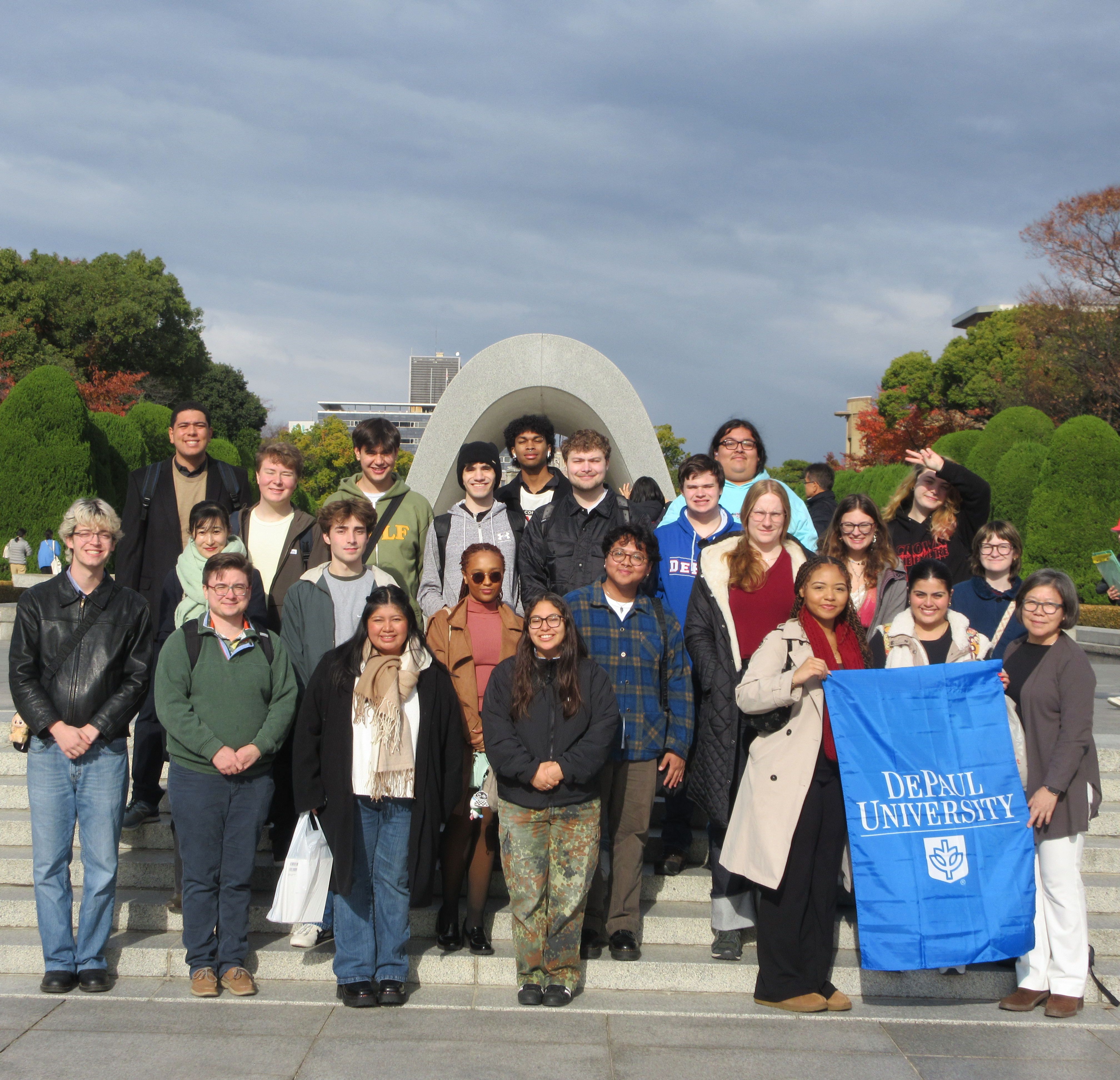
 DePaul students studied abroad in December 2024 in Hiroshima, Japan. In this photo, they stand in front of a cenotaph in Hiroshima Peace Memorial Park. (Photo courtesy of Yuki Miyamoto)
This year marks not only the 80th anniversary of the U.S. atomic bombing of Hiroshima and Nagasaki, Japan, but also the anniversary of the first atomic bomb testing in Alamogordo, New Mexico. The effects of the bombings are still felt today in all three locations and elsewhere around the world.
Satoshi Tanaka, a journalist and Hiroshima survivor, will headline the event, and represents the
2024 Nobel Peace Prize-winning group,
Nihon Hidankyo. Joining Tanaka on stage will be Myrriah Gómez, an associate professor in the Honors College at the University of New Mexico and the author of “Nuclear Nuevo México: Colonialism and the Effects of the Nuclear Industrial Complex on Nuevomexicanos.”
Nihon Hidankyo is a confederation of groups representing Hibakusha, individuals who are sufferers of the atomic bombings of Hiroshima and Nagasaki. The group was awarded the
Nobel Prize “for its efforts to achieve a world free of nuclear weapons and for demonstrating with witness testimony that nuclear weapons must never be used again.”
In this Q&A,
Yuki Miyamoto, professor of religious studies and director of the DePaul Humanities Center, discusses the lasting damage of nuclear weapons and how they have affected her own family.
What can you tell us about the group Nihon Hidankyo and Satoshi Tanaka?
As we get further away from when the nuclear bombings occurred, it becomes even more helpful for students to attach a face and a personal story to what they read in history books. To have someone like Satoshi Tanaka come to DePaul is a huge honor. He was exposed to residual radiation as a one-year-old as his mother searched for family members two days after the bomb dropped on Hiroshima. He has since spent his life as a journalist and researcher in Hiroshima and currently serves as the representative director of Nihon Hidankyo, the organization that has spent nearly 70 years fighting for the abolition of nuclear weapons globally and supporting individuals affected by nuclear weapons.
I’m so excited for the Humanities Center to host space to discuss such an important topic with individuals who have lived with the reality of nuclear weapons throughout their lives.
Why is it important to remember nuclear events that occurred 80 years ago?
I think many people aren’t aware of the lasting effect the dropping of nuclear bombs has on the area and its people, even if it’s just a test. For example, there were an
estimated 13,000 people, many indigenous and Hispanic communities, living within 50 miles of the Trinity test covered in the movie “Oppenheimer,” who in the years following developed cancers and other health issues. In Hiroshima and Nagasaki, besides the hundreds of thousands who died immediately from the bombs, an untold number died from health issues or were born with developmental issues directly linked to the bombs.
These three instances are some of the most famous but are far from the only use of nuclear weapons. There have been over 2,000 nuclear tests worldwide since 1945, just over half done by the U.S. But the U.S. isn’t the only culprit. There are eight other countries in the world with nuclear capabilities, and nearly all have tested in places like the Marshall Islands, Algeria, Western Australia and over our world’s oceans. That means nuclear materials have been spread all over the world, into our water supply, into our oceans, into the food we eat and into people. These are chemicals and dangerous elements that can take hundreds of thousands of years to be safe. Just because nuclear testing has stopped for now doesn’t mean we won’t still be feeling the effects of these tests for the rest of human existence.
This topic hits you close to home. Will you share about your family’s experience with nuclear bombs?
My mother, who was six years old, was at school a mile away from the hypocenter of the atomic bomb that was dropped on Hiroshima. I honestly don’t know how she survived because 100 of her classmates died that day. My grandfather was coming home from work when he experienced the bomb. He was okay initially but died two weeks later from acute radiation sickness. While my mom survived the bombing, she had severe health issues her whole life and ultimately developed cancer in her 50s and died when she was 62. Growing up in Hiroshima, everyone has a family member who was affected by the nuclear bomb, and it’s considered normal.
Wednesday, Oct. 29
6-7:30 p.m.
Lincoln Park Campus Student Center, Room 120
Free and open to the public