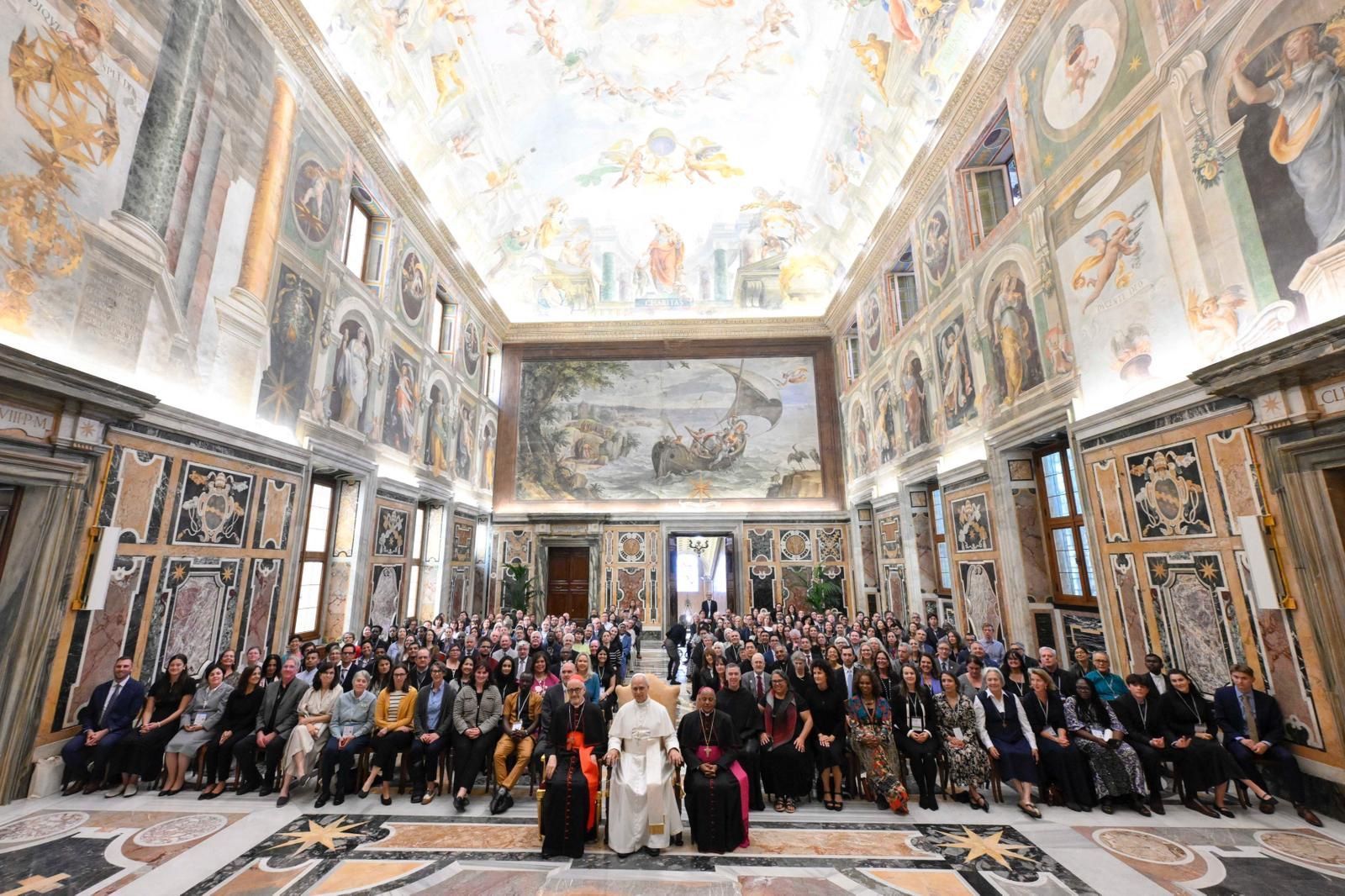
 The "Refugees and Migrants in Our Common Home" conference group met with Pope Leo XIV to explore how to uphold human dignity while addressing migration issues. (Vatican Media)
Heeding the call from the Catholic Church to uphold human rights and dignity, the
DePaul Migration Collaborative joined with other academic institutions and nonprofits in Rome to share global perspectives on migration.
The program, an interdisciplinary collaborative between the College of Law and College of Liberal Arts and Social Sciences, works with students, alumni and legal practitioners to pursue advocacy and research in migration, mobility and human rights.
Jill Nyhof Rodriguez, senior program manager for the DePaul Migration Collaborative, attended the conference “Refugees and Migrants in our Common Home: Mobilizing Academic Communities,” organized by Villanova University in collaboration with the Catholic Church, in early October. The group launched the initiative in response to a call from the late Pope Francis, urging universities to use their expertise to act on migration and refugee issues with the goal of upholding human dignity.
“There were representatives from areas of mass migrations, from throughout Africa and Jordan and Syria,” Nyhof Rodriguez says. “I appreciated the perspective from their communities. Our office is very Chicago-focused, so we are now able to incorporate a global view of these issues and see what models we can adapt to our urban setting.”
Conference participants met with Pope Leo XIV, who encouraged them to incorporate themes of reconciliation and hope into their plans.
“One of the obstacles that often arises when dealing with difficulties of such great magnitude is an attitude of indifference on the part of both institutions and individuals,” Leo said in his address to the group. “I would encourage you, therefore, to propose concrete ways to promote gestures and policies of reconciliation, particularly in lands where there are deep-seated wounds from long-standing conflicts.”
Leo has carried on his predecessor’s pursuit of care for migrants, refugees and other displaced persons, a topic Francis discussed in his final public address.
The DePaul Migration Collaborative will use the global perspectives from this conference moving forward in its work.
“We're starting to pursue more globally focused projects, looking at how other cities shelter migrants and seeing how we can translate this work to Chicago institutions,” Nyhof Rodriguez says.