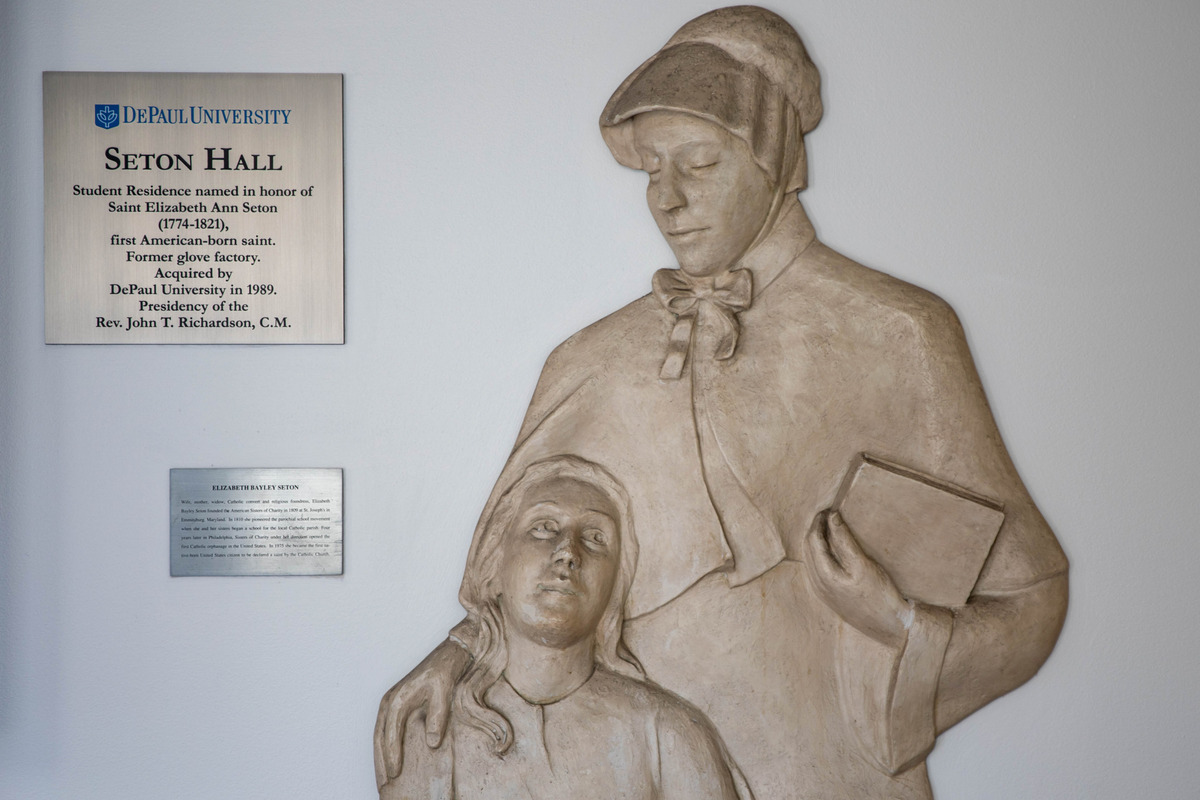
 Student dormitory Seton Hall was named after the saint, honoring her with a statue in the building (Photo by Lavanya Chetal / DePaul University).
When Elizabeth Ann Bayley Seton attended mass for the first time in 1804, she was in awe of the beautiful artwork and gilded ceilings of the Catholic church in Italy. This experience set her on the path to become the first Catholic saint born in North America.
“Her dream was to teach young girls how to read and write, and about their faith,” says Sister Betty Ann McNeil, D.C., a Vincentian researcher who is on the board of DePaul’s
Vincentian Studies Institute. “Her mission statement was to prepare the students for the world in which they were to live.”
As the world marks the 50th anniversary of Seton’s canonization this fall, DePaul is collaborating with the Daughters of Charity to make her writings more accessible than ever before. Supported by a generous gift from the
Congregation of the Mission, archivists at DePaul and the Daughters of Charity are working together to digitize over a thousand documents written by Seton and her family. Explore the first round of uploaded files through
DePaul’s Digital Commons.
“Seton’s Sisters of Charity are part of our global Vincentian family,” says Joyana Dvorak, associate director for Student Engagement & Mission Integration at DePaul. “The sisters were shaped and formed with the same approach to service, which is rooted first and foremost in dignity.”
Seton was the first people to inculcate the Vincentian spirit in the U.S. She translated many of the writings of St. Vincent de Paul and St. Louise de Marillac from French into English for her sisters to read. She also modeled her community — the Sisters of Charity of St. Joseph’s — on de Marillac’s Daughters of Charity of Paris, embracing its values and principles in her instructions to students and sisters.
“Mother Seton read all the Vincentian literature that the priests had brought over from France and used that to instruct the sisters on how to provide compassionate care for others. The Sisters of Charity that she established became Vincentian women, who then went forth and established orphanages, hospitals and served as nurses on the battlefields of the United States Civil War,” says McNeil.
A deeper understanding of St. Elizabeth Ann Seton
The Sisters and Daughters of Charity at Emmitsburg, Maryland, have held Seton’s physical papers since her passing in 1821. For many years, the way to read Seton’s writings was a collected volume of transcriptions that excluded other papers, like the letters her family wrote to her.
Scott Keefer, provincial archivist at the Daughters of Charity, says the digitization of her papers can provide researchers with a more holistic understanding of Seton and her life. Researchers accessing the digitized documents can now view details including the kind of paper used, crossed-out text, enlarged writing, and words rewritten in the margins.
McNeil agrees seeing the text in Seton’s handwriting is eye-opening.
“You can tell if she gets interrupted and can see where she underlines or capitalizes things for emphasis. You can feel the sense of emotional energy going into the communication,” McNeil explains. “It’s one thing to be able to read the writings, but when you see how she formed her letters, it takes you back to where she was and what was going on at the time.”
Importantly, digitizing the documents makes them more searchable and organized, without disrupting the original order or previous citations. As more letters are added to the Digital Commons, search results will become even more useful to researchers.
Sharing Seton’s letters online is a tedious process, Keefer explains. For each of the 36 boxes in the Daughters of Charity’s collection, archivists survey the box and check the condition of each of the papers within it. Then they scan it, clean and update old metadata, check transcriptions for errors, and correct them. Finally, they create a digital package that is sent to the Vincentian studies Institute to be uploaded to the Seton Family Papers site.
For more information, visit DePaul’s resources on Saint Elizabeth Ann Seton
here.