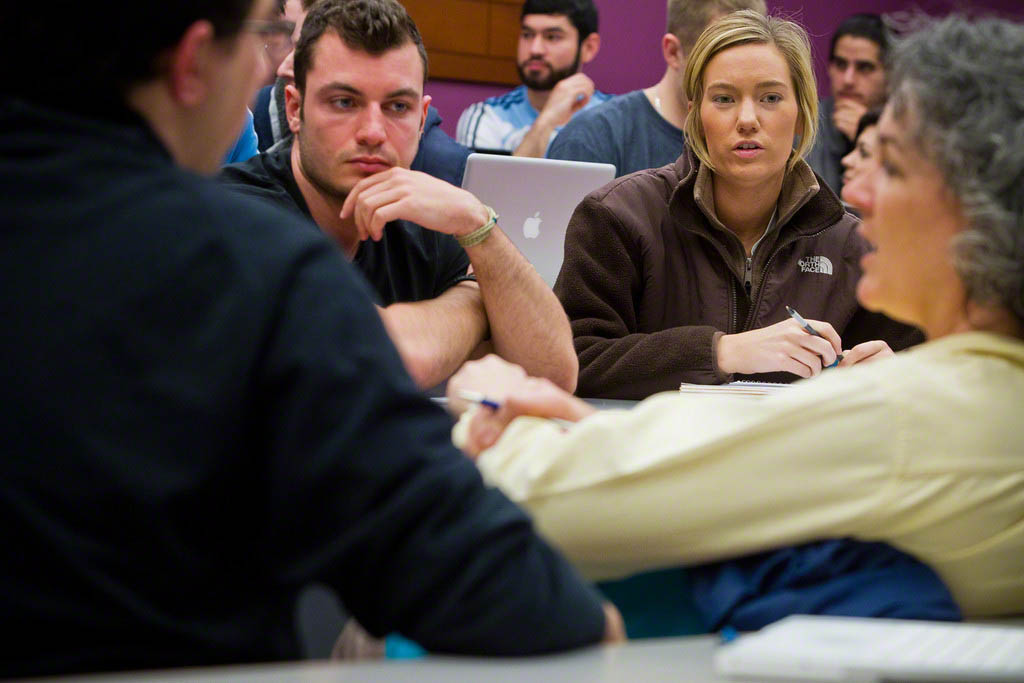
Critical thinking is a catchall phrase used to describe the ability of students to think for themselves, to reason well, and to approach problems and issues in a systematic and logical manner. The following resources offer suggestions for designing assignments that strengthen critical thinking.
Stephen Brookfield On Critical And Creative Thinking
The
2012 Fall Forum on Teaching and Learning featured a keynote presentation by the noted expert on adult education, Stephen Brookfield, who is the John Ireland Endowed Chair at the University of St. Thomas in St. Paul, Minnesota. You can watch the keynote below.
Handouts On Teaching For Critical Thinking
Further Resources
Bean, J.C. (2001). Engaging Ideas: The Professor's Guide to Integrating Writing, Critical Thinking, and Active Learning in the Classroom. San Francisco: Jossey-Bass.
Brookfield, Stephen. (2011).
Teaching for Critical Thinking: Tools and Techniques to Help Students Question Their Assumptions. San Francisco: Jossey-Bass.
Example Activities for Critical Thinking
These activities were created by members of the Critical Disinformation Studies (2025)
Faculty Learning Community.
These works are licensed under
CC BY-NC 4.0

 They are available for download and repurposing for non-commercial use, with attribution to their authors.

Illustration by Pablo Stanley
Annotated Bibliography Assignment for the Post Truth Era
Author name: Tim Elliott
Type of activity: Annotated bibliography
Description:
This annotated bibliography assignment emphasizes evaluating sources for credibility. Useful in WRD 103/104 & LSP 112. Worth considering for any research writing-related course where a research paper is a major deliverable.
Learn More

Illustration by Leni Kauffman
Combatting Biological Misinformation through Prebunking Strategies
Author name: Beth Shaffer-McCarthy
Type of activity: Lecture + homework assignment
Description:
This activity introduces students to the concept of prebunking as a means to inoculate media consumers to common misinformation related to biology and health.
Learn More
Illustration by Elina Cecilia Giglio
Biological Anthropology in Popular Media
Author name: Rachel E. Scott
Type of activity: Class discussion
Description:
This in-class activity for ANT 104 Introduction to Biological Anthropology asks students to critically evaluate how topics in biological anthropology are communicated to popular audiences.
Learn More

Illustration by Ivan Mesaroš
Misinformation and Propaganda About the War in Ukraine
Author name: Maria Prikhodko
Type of activity: In-class activity
Description: This is an in-class role-playing (simulation) activity focused on Ukraine in media and global audiences.
Learn More

Illustration by Bonnie Kate Wolf
Cross-Cultural Conflict Activity
Author name: Veronica Appleton
Type of activity: Role-play Activity
Description:
In this interactive dialogue students will gain a deepened understanding of how to manage intercultural harmony when conflict arises from disinformation. Through dialogue and reflection, students will deepen their understanding for communication, culture and cross-cultural intelligence while managing conflict.
Learn More

Illustration by Pablo Stanley
Human-Written vs AI-Generated Cover Letter
Author name: Marco Chou
Type of activity: Homework assignment
Description:
This is a homework assignment in IT390 Introduction to Generative AI class. I ask students to compare a human-written cover letter vs. an AI-generated cover letter using an individual's resume along with a job description posted on the job website.
Learn More

Illustration by Gustavo Pedrosa
Re-Contextualized Fairytales: A Storytelling Activity
Author name: Alex Mallory
Type of activity: Group activity
Description:
Students in ACT 217: Art of Storytelling add contextual information to the presentation of well-known fairytales to influence the audience’s interpretation of the story.
Learn More