Types of Transcription
Instructors can create transcripts of Zoom meetings. These transcripts can come in the form of text (Meeting Transcription) or audio (Audio Transcription), and a text transcript is automatically created that can be downloaded for later use or to share with the class.
Transcription must first be enabled before it can be used in meetings.
There are several key differences between Meeting Transcription and Audio Transcription:
| |
Zoom Meeting Transcription
|
Audio Transcription
|
|
Purpose
|
Provides a written record of spoken content during live meetings.
|
Generates a text file from recorded audio after the meeting.
|
|
Format and Availability
|
Typically displayed as live captions during the meeting.
|
Saved as a separate VTT file after the meeting.
|
|
Editing
|
Not editable during the meeting. Captions are temporary.
|
Editable after the meeting in the Web portal.
|
|
Language Support
|
Primarily supports English.
|
Primary transcript language can be changed to re-generate the transcript after the fact.
|
Meeting Transcription
Enabling Meeting Transcription
Meeting Transcription allows for live transcription during meetings, providing immediate visual access for participants. It is useful for accessibility, especially for deaf or hard-of-hearing participants. Captions are generated in real-time and can be displayed as subtitles during the meeting. This feature is most useful for live events when immediate accessibility is required.
- Sign in to depaul.zoom.us.
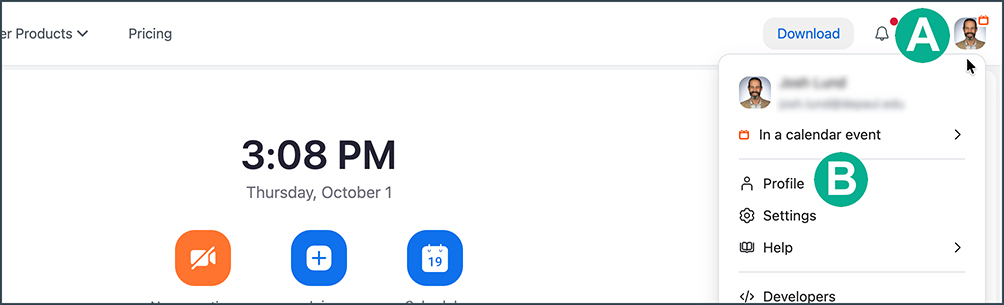
- Select the profile picture [A] near the top of the screen.
- Select Settings [B].
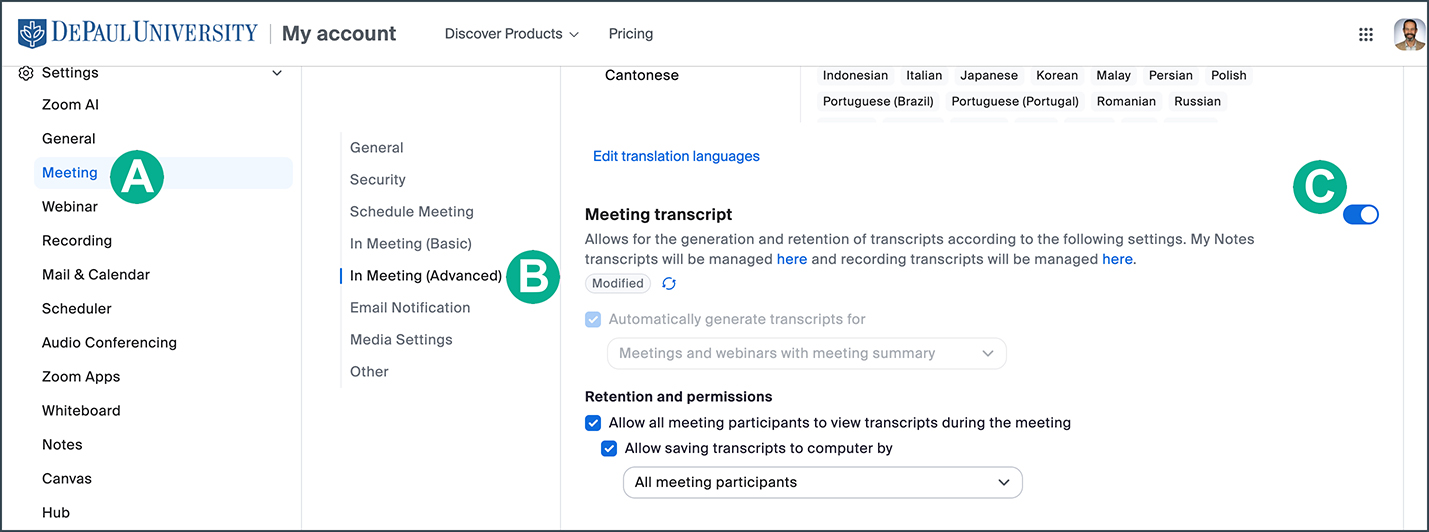
- Select Meeting [A].
- Select In Meeting (Advanced) [B].
- Toggle the Meeting Transcript switch [C] to enable or disable it.
- (Optional) Select or clear the checkboxes next to the following sub-settings to enable or disable them, then select Save:
- Automatically generate transcripts for: Automatically generate transcripts for all meetings or meetings that have a summary.
- Retention and permissions:
- Allow all meeting participants to view transcripts during the meeting: Choose whether to allow all meeting participants to view transcripts during the meeting.
- Allow saving of transcripts to computer by: If participants are allowed to view transcripts during the meeting, they may be allowed to save transcripts themselves. Options include the host only, host and co-hosts, all participants who are not guests (external participants), all participants with the specified IP addresses or ranges, and all meeting participants.
Starting and Stopping Meeting Transcription
- Start a Zoom meeting.
- In the meeting controls toolbar, select More, and then select Transcript. The meeting transcript will start.
- To stop the meeting transcription, hover over the Transcript icon, then select Stop Transcription. A confirmation window will appear.
- (Optional) In the window, select the Delete Transcript checkbox.
- Select Stop Transcription.
Requesting a meeting transcript during a meeting
- Join a Zoom meeting.
- In the meeting controls toolbar, Select More, then select Transcript. The Ask host to start transcription window will appear.
- Select Request Transcription. The host will receive a prompt where they can choose to Decline or Start transcription.
- (Optional) In the top-right corner of the meeting window, hover over the Transcript icon, and then select Ask Host to Stop Transcription.
Accessing and Saving Meeting Transcripts During a Meeting
- Start or join a Zoom meeting.
- In the meeting controls toolbar, select More, then select Transcript.
- The Transcript panel will open. As participants speak during the meeting, the transcript will populate.
- At the bottom of the Transcript panel, select Save Transcript. The .TXT file will be saved to the device.
- Select View in Folder or Finder to access saved transcripts. By default, Zoom will save transcripts in the following folder on the computer:
- Windows: C:\Users\[Username]\Documents\Zoom
- Mac: /Users/[Username]/Documents/Zoom
- Linux: home/[Username]/Documents/Zoom
Audio Transcription
Audio Transcription automatically transcribes the audio of a recorded meeting or webinar. After processing, it creates a separate text file (VTT format) that can be viewed and edited later. Audio Transcription is best for reviewing and documenting processes after meetings have ended. Users can access a written record of discussions, which can be useful for note-taking and reference.
Enabling and Generating Audio Transcripts
- Sign in to depaul.zoom.us.
- Select the profile picture near the top of the screen.
- Select Settings, and then select the Recording tab.
- Locate the Cloud recording setting and verify that it is enabled.
- If the setting is disabled, select the toggle to enable it. If a verification dialog appears, select Enable to verify the change.
- In the Advanced Cloud Recording Settings section, select the checkbox next to Create Audio Transcript to enable it, then select Save to confirm the change.
When a meeting is started with recording to the Cloud enabled, the instructor will be notified via email after the meeting that the cloud recording is available. This email includes links to view recordings or audio transcripts.
Note: Once the Cloud recording becomes available, the audio transcript may take additional time to process.
Viewing or Editing Audio Transcripts
Note: Audio transcripts are saved in VTT format. The downloaded file can be opened with a text editor or word processing application, or it can be viewed or edited in the web portal.
- Sign in to depaul.zoom.us.
- Select Recordings. A new window will open.
- Select the Cloud recordings tab. (It is usually selected by default when the window opens.)
- Select the name of the recorded meeting. A list of recording files is displayed.
- Select the icon next to the recording name. A new tab will open that plays the recording and displays the audio transcript.
- Hover over a phrase to be edited and select the pencil icon.
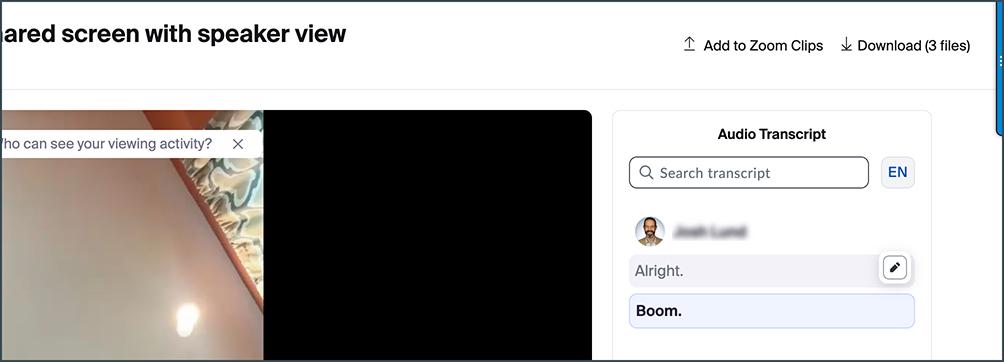
Note: If a phrase belongs to an unknown speaker, hover over Unknown Speaker and select the pencil icon to edit their name.
- Select the checkbox to save changes. The updated version of the text will be displayed when the audio or video file is played.
Displaying a transcript as closed captions
Note: The transcript is automatically embedded within the audio and video file, but is hidden by default.
- Sign in to depaul.zoom.us.
- Select the profile picture [A] near the top of the screen.
- Select Profile [B].
- Select Recordings & Transcripts.
- Select the Cloud recordings tab. (It is usually displayed by default.)
- Select the name of the recorded meeting. A list of recordings is displayed.
- Select the preview picture of the recording containing the transcription. A new tab will open that plays the recording and displays the audio transcript.
- In the bottom-right corner of the recording playback screen, select the CC icon. The text displays on top of the video, similar to closed captioning.

Searching for text in audio transcripts
- Sign in to depaul.zoom.us.
- Select the profile picture [A] near the top of the screen.
- Select Profile [B].
- Select Recordings & Transcripts [A].
- Select the Cloud recordings tab [B]. (It is usually selected by default.)
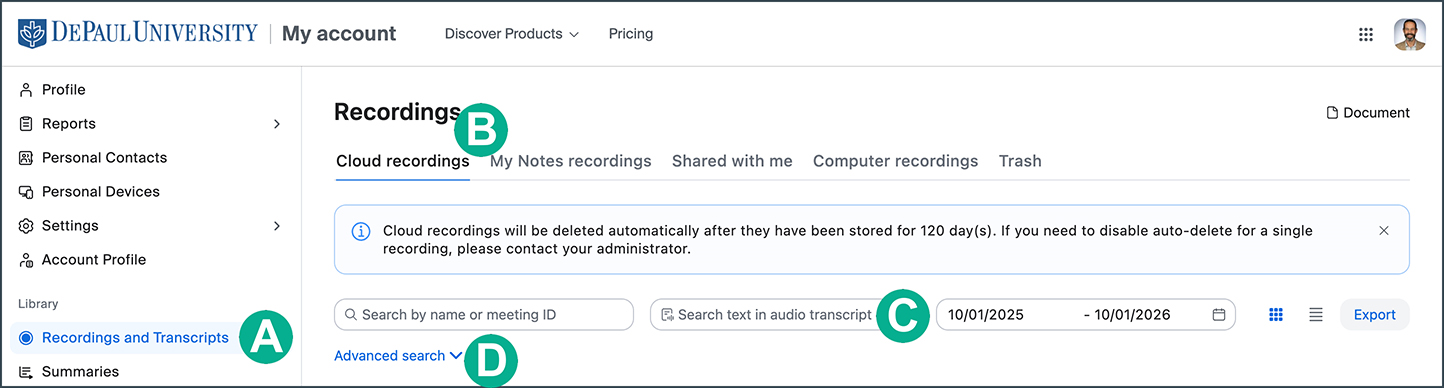
- In the Search text in audio transcript field, [C] enter a word or phrase. Recordings with matching text will be displayed.
- (Optional) Under Advanced search [D], adjust these fields to filter the search:
- Data range
- Host
- Storage location
- Select Search or press Enter on the keyboard.
- To the right of the highlighted text, select View more results. A new tab will open that plays the recording and displays the audio transcript.
Changing the original language of an audio transcript
By default, audio transcripts for cloud recordings are generated in English, but the default language can be chosen for a recording and have the transcript regenerated.
- Sign in to depaul.zoom.us.
- Select the profile picture [A] near the top of the screen.
- Select Profile [B].
- Select Recordings & Transcripts.
- Select the Cloud recordings tab. (It is usually selected by default.)
- Select the name of the recorded meeting. A list of recording files is displayed.
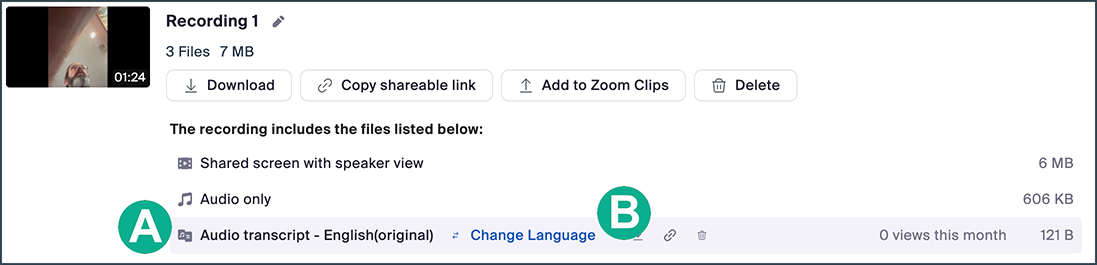
- Hover over the Audio transcript file [A] to be changed, then select Change Language [B].
- Select from the available languages in the dropdown menu.
- Select Save. Zoom will reanalyze and transcribe the audio in the newly selected language.